Insulin is the injectable medication you use to control your diabetic dog’s blood sugar. When insulin therapy is first started, the optimal dose for your pet will be unknown and will have to be determined by trial and error.
Most dogs will need insulin injections twice a day, though occasionally, a patient is found where a single dose is long-acting and once-a-day insulin works out. A dose will be selected based on what research has shown to be a good starting point, and after a week or two, a glucose "curve" will be needed to map out the blood sugar levels over the day. This has traditionally been done in the hospital with blood glucose samplings done every 2 hours during the hospital's hours of operation. Alternatively, a continuous monitor such as a FreeStyle Libre® (made for human use) can be implanted on the pet's skin. Several curves can be obtained at home via a special reader or cell phone. The curve or curves will show if the insulin is lasting long enough and if the dose should be raised, lowered, or kept the same.
Alternatively, you can learn how to monitor your dog’s blood glucose levels yourself, but if you are a beginner, you may want to master giving the injections before moving on to taking blood samples. If you become proficient at glucose sampling, you can perform the curve at home and message the results to your veterinarian, skipping the stress and expense of a hospital visit. This may not seem like a valuable technique to learn now that continuous monitors can be implanted, but going forward, you may want to be able to periodically (or even regularly) do glucose spot checks at home, and for that, you would need your own glucose meter and glucose strips.
There are several insulins used in the management of diabetic dogs. Vetsulin®, Humulin N®, and Novalin N® are intermediate-acting insulins. Vetsulin® is of pork origin, but pork and dog insulin are identical, so Vetsulin®, (also called "Caninsulin" in other countries) is a veterinary product. Humulin N and Novalin N are human insulins available from human pharmacies. ProZinc® insulin is another veterinary insulin, while Glargine insulin and its variations are human products, all designed to last a bit longer than Vetsulin®, Humulin N and Novalin N. Vetsulin®, Humulin N, Novalin N, and Glargine are available in both vials (where one draws insulin out with a syringe) and pens (where a dose is dialed in and a button is pressed to deliver the injection). ProZinc is available only in a vial. Human insulins are much more concentrated than veterinary insulins and require special syringes. Many people prefer the ease of the pen, but it can be tricky if half-unit doses are needed depending on which insulin pen we are talking about.
Be sure you understand how much insulin you are supposed to give your pet.
Do not change your pet's insulin dose without veterinary guidance.
Storing Insulin
Insulin does not require refrigeration, but since many insulins do not contain preservatives, it is best to refrigerate the product since we want it to last a couple of months without bacterial contamination. Human diabetics frequently do not refrigerate their insulin at all, but as human doses are substantially larger than animal doses, the vial or pen will not need to last nearly as long. The bottom line is that it is best to refrigerate the pen or vial to maximize the shelf life of the product. Unopened vials or pens should be stored in the refrigerator.
- Do not use insulin that is past its expiration date.
- It is a good idea to change to a fresh bottle every 6 to 8 weeks. That being said, the standard in veterinary medicine is to keep it longer; 4-6 months as long as the insulin is refrigerated and not discolored. Please consult your veterinarian about what will work best for you and your pet.
- Do not use insulin that has been frozen. Insulin is not normally frozen, but accidents happen, especially in smaller refrigerators.
- Do not expose insulin to direct light or heat.
Syringes for Use with Vials
Human and veterinary insulins are made at different concentrations, and thus, each requires its own type of syringe for proper dosing. Insulin syringes are extremely small in diameter so that injection will not be painful. It is a rare patient that objects to insulin shots per se, but some dogs resent being held still. It is crucial that the injection goes into the dog rather than into the fur of the dog. The best area for injection is around the shoulders but, if possible, the area of the injection should be changed up with each injection from right to left for best insulin absorption.
- Vetsulin® is available at 40 units of insulin per cc and requires U-40 syringes.
- Humulin N is available at 100 units of insulin per cc and requires U-100 syringes.
Always be sure you have the correct syringes for your insulin.
Used syringes should be placed inside a thick plastic container, such as a liquid laundry detergent bottle or similar receptacle. If the needle is enclosed in such a container, the entire container can be closed up and disposed of in the regular trash at home. Specific containers can be purchased for needle disposal, or the used syringes can be returned to your veterinary hospital for disposal if you prefer. Some states, such as California, have specific regulations for disposing of used insulin syringes (commonly called sharps).
How to Give the Injections

Insulin is drawn into the syringe after holding the bottle upside down. Photo courtesy Teri Ann Oursler, DVM
First, feed your dog.
A dog's blood sugar that has not eaten a normal meal but receives insulin may drop to a dangerously low level. If your dog is not eating, this could indicate a need for a checkup with your veterinarian.
After the dog has eaten, you are ready to give the injection. (Note, there is an exception to this rule. Novalin N appears to last longer if given before feeding. No one knows why this is and, as mentioned, this practice runs the risk of giving insulin to a pet that may not offset the insulin dose with calories.)
Before drawing up the insulin, it is important to be sure that the insulin is properly mixed as some of it will settle on the bottom of the vial. The manufacturer of Vetsulin® recommends simply shaking the bottle until the contents are uniformly milky.
The manufacturers of other insulins recommend gently rolling the bottle in the palms of your hands or rocking it back and forth lightly to mix. The only product that should be shaken to mix is Vetsulin®.
When drawing up the insulin, always hold the bottle vertically and upside down to avoid unnecessary bubbles in the syringe. (See photo.) Since insulin is being given under the skin, bubbles are not an enormous problem as it would be with an intravenous injection but we still want to minimize bubbles. If you get bubbles in the syringe, flick the syringe with your fingers until the bubbles rise to the top, and then simply push the air out of the syringe with the plunger.
insulin administration dog Brooks
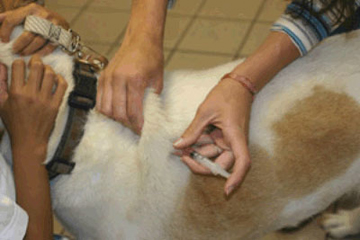
Photo courtesy of MarVistaVet.
After you have the insulin dose ready in the syringe, it is time to get your dog. Be sure you can trust your dog to hold reasonably still for the shot. Most dogs do not require a second person to hold them still but some dogs are rambunctious and a helper is necessary. If you have such a pet but no helper, consider tying a short leash around a piece of furniture. (Use a slip knot in case of a choking emergency.) Some dogs are uncooperative and require a muzzle.
Lift up a fold of skin, ideally along the side of the body. This will create a small space for the needle. Insert the needle into this space and inject the insulin. Withdraw the syringe and needle when you are finished.
Insulin by Pen
An insulin pen is a gadget that allows precision insulin measurements and push-button ease of administration. The gadget is called a pen because it is shaped like a writing pen. A cartridge of insulin is snapped inside, and a small needle tip is applied to the pen tip (a new tip should be used each time). The dose is dialed in with accuracy up to the half unit, which is much more accurate than trying to eyeball tiny doses with a syringe. The pen is primed with a dose before it is used on the patient. You insert the needle through the pet's skin and press a button at the top. The needle must stay in place for at least five seconds to ensure the full dose has been delivered. Most people find this method of insulin delivery easier than using syringes.
Most human insulins are available as pens, but Vetsulin® is the only veterinary insulin available in a pen. Vetsulin® pens are sold separately from their insulin cartridges. The cartridges should be stored upright, though the loaded pen may be stored on its side. Most human insulin pens are disposable and cannot be reloaded.
Pens cannot be refrigerated without disrupting their measuring mechanism. This means that the insulin cartridge within the pen is good for about six weeks before it must be discarded and replaced. The needle's tips should be disposed of with the same precautions as for syringe disposal.
Giving injections and becoming comfortable with needles may seem intimidating at first but you will most likely be surprised at how easy it quickly becomes. Managing a diabetic pet is definitely a project but can be a very rewarding one. If you have any questions or problems, remember your veterinarian's office is available for demonstrations or to answer your questions as they come up.
It is our policy not to give dosing information over the Internet.